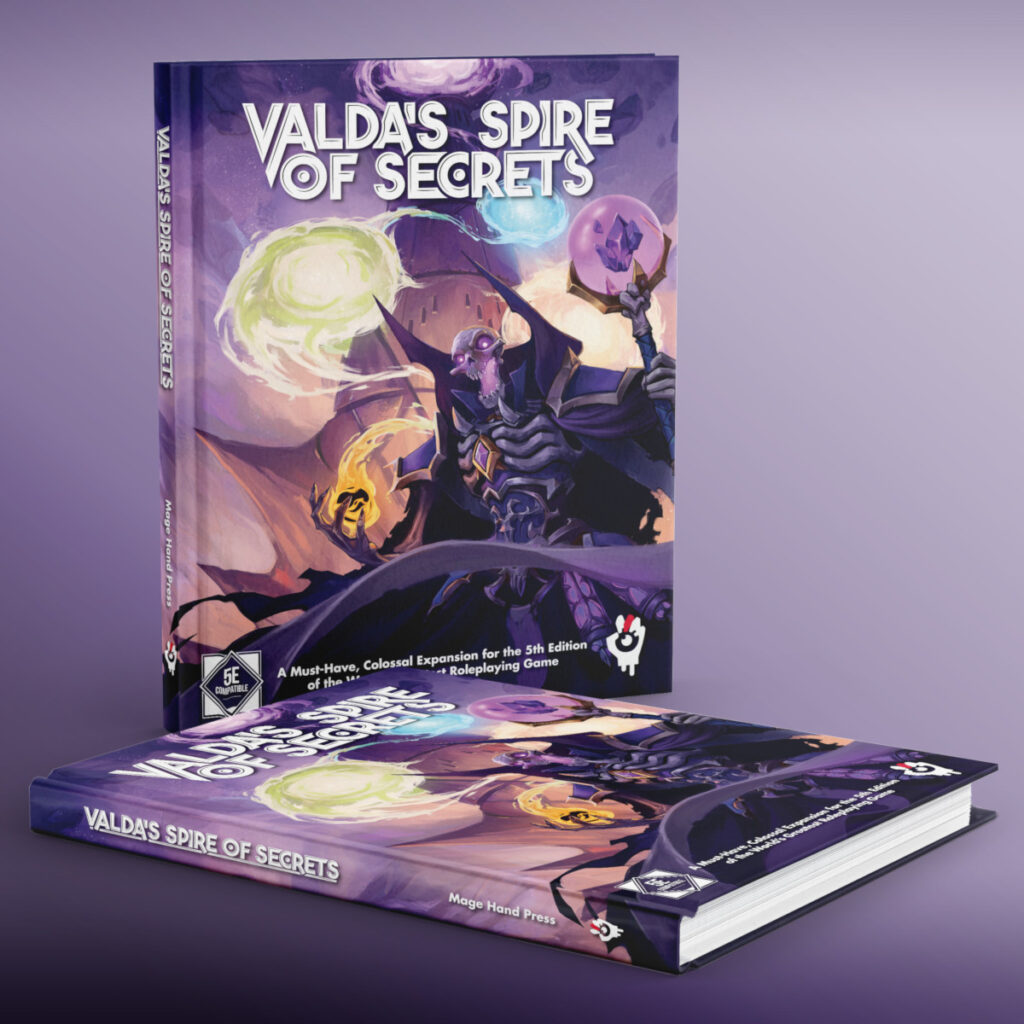
Bring home everything this class has to offer with the Complete Necromancer
The Necromancer class does exactly what it says on the tin: you get to control an army of Undead and eventually become a lich! Of course, juggling control over a half dozen Thralls and a full spellcasting list can be a challenge even for veteran players. This guide will break down the science of Necromancy and give you a headstart down your dark path.
It’s part of an ongoing series of guides we’re writing for Mage Hand Press classes; click here to find a guide for your favorite class!
Army of Undead
Starting at Necromancer level 2, you have direct control over Undead minions called Thralls. You animate them over a 10-minute ritual which doesn’t require spell slots, and they fight alongside you in combat without requiring any actions on your part. They’re simply additional monsters you control during combat.
Furthermore, your Thralls use your spell attack bonus for attacks, so your Zombies won’t constantly miss their attacks as you climb to higher levels. Starting at Necromancer level 5, you can also cast Animate Dead in the middle of combat to replenish your thralls!
We’ll cover how to choose your thralls and manage them later on. For now, it’s just important to understand that you’ve always got a handful—usually between 2 and 6—minions under your control.
Tricks in Combat
Your Thralls aren’t the only trick up your sleeve! You also have two features that make you surprisingly dangerous in combat: Critical Spellcasting and Charnel Touch.
Critical Casting comes online at Necromancer level 5 and does two things: expands the Critical Hit range for your spell attack rolls to 19-20 and causes actual honest-to-god Critical Failures when an enemy rolls a 1 on a saving throw. Nobody is safe from your spellcasting and any saving throw can turn dramatically sour in an instant.
You also have the Necromancer’s Charnel Touch—the polar opposite of a Paladin’s Lay on Hands. You touch someone with a spell attack and deal Necrotic damage. You choose the damage out of the pool, just like a Paladin’s pool of healing, and the damage is doubled if you score a Critical Hit. Use your Charnel Touch whenever you need to get out of a tight spot! Unlike other spellcasters, the Necromancer has limited ways to escape a dangerous enemy, so you should use your Thralls and your Charnel Touch to simply remove that enemy from the equation.
Thralls Out of Combat
Out of combat, you can heal your Thralls using their own Hit Dice over a Short Rest and you can also expend your Charnel Touch points to heal them! If you start running low on Charnel Touch, you can use your Level 3: Dark Arcana feature to trade spell slots for more points.
Support Spellcasting
The Necromancer’s spellcasting is designed to make the battlefield a very dangerous place for your enemies. You have spells to support your army of minions, deal large area damage, and otherwise be a menace, but you don’t have a lot of high damage burst spells!
You should choose your spells carefully to avoid harming your Thralls and allies, but you should also think about your spells as placing one additional wall between a dangerous enemy and yourself.
Managing Your Thralls
Unlike a Wizard, which can control game-breaking numbers of Zombies with the Animate Dead spell, the total number of Thralls you can control is limited in two ways:
- The combined Challenge Rating of your controlled Thralls can’t exceed a total shown in the Necromancer table.
- You can’t have more thralls than what’s shown in the Necromancer table (a maximum of six).
The class also only allows a set of 7 thralls with some intentional gaps in CR in order to keep the steady progression of minions balanced and fun. Here’s a breakdown of the first few levels of your thrall options:
Necromancer Thralls by Level
| Level | Thralls |
| 2 | 1 Spirit, Skeleton, or Zombie |
| 3 | 2 Spirits, Skeletons, or Zombies |
| 5 | 1 Bonebeast or Gorger, or 2 Spirits, Skeletons, or Zombies |
| 7 | 1 Deadnaught, 1 Bonebeast or Gorger, or 3 Spirits, Skeletons, or Zombies |
| 10 | 1 Deadnaught, 1 Bloodlurk, 2 Bonebeasts or Gorgers, or 3 Spirits, Skeletons, or Zombies |
As you can see, your choices aren’t that complicated until you reach level 10 and your Thrall CR total increases to 2. This list also isn’t complete—you can mix and match to some extent.
If you want to make the choice very simple, just compare two things: the biggest minion you can have at once, versus the most minions you can have. Often, this is a direct competition between an armored Deadnaught and a crew of Skeletons to pincushion your enemies.
Deadnaught
Starting at Necromancer level 7, you can opt out of your army of minions and control a single dangerous Thrall instead. The Deadnaught is a scaling, customizable statblock with weapon and armor proficiencies so you can load it down with magic weapons and armor. It has Multiattack, generous AC, and a lot of Hit Points—nothing to sneer at!
You’ll often get a bit of extra damage out of a crew of Skeletons and extra HP out of a wall of Zombies or similar, but the Deadnaught is easy to manage and fun for roleplaying, so consider giving it a try.
Crew of Skeletons
Never underestimate the power of having 3–4 free ranged attacks every turn. Skeletons don’t have great AC, they’re quite fragile, and their damage isn’t individually something to write home about, but they come with Shortbows that deal 1d6 + 3 damage on a hit. That adds up quickly!
If you come face-to-face with a Fireball or a dragon’s breath weapon, you stand to lose your whole crew. Once you reach level 7, however, your Thralls get Avoidance (Evasion for all saving throws) to prevent this scenario from being quite so devastating.
Click here to see all the Undead Thralls you can play as part of the core class features available on our website.
Roleplaying a Necromancer
You are a radical at the bleeding edge of arcane science, pushing the boundaries of ethics and ambition.
As you’re building your Necromancer, consider what might have led your character to this extreme view of mortality, how they acquired the knowledge to pursue it, and what kind of person that pursuit has molded them into.
Here are some personality traits, bonds, ideals, and flaws hand-picked for the Necromancer class. Start by choosing a personality trait from the following list, or rolling a d8 to choose one at random.
Necromancer Personality Traits
- I have difficulty looking people in the eye or giving straight answers to direct questions.
- I have no use for emotional outbursts like tears.
- Disembodied skulls have given me some of the best conversations I’ve had.
- I list aloud the injuries I see and prioritize them by severity.
- I feel stifled sleeping under a roof.
- I’m not squeamish about blood, and I don’t understand why anyone would be.
- I refer to creatures by their scientific names so as to avoid unnecessary attachments.
- I can give an expert’s dissertation on the variety and proper application of shovels, and will do so at the slightest opportunity.
What do you want?
These are your “bonds”—desires that help you determine the answers or solutions your character will choose if available. Choose one from the following list, or roll a d6 to choose one at random.
Necromancer Bonds
- I must find the best body parts to complete my masterwork.
- It took me too long to figure out I was living in a cult; I must avoid the active members who want to bring me back into the fold.
- A former mentor insulted my work, and I’m determined to prove my methods are superior to his.
- I lost someone I loved too soon. I mean to get them back no matter how I have to do it.
- One day, I will discover the means to cheat death, so I can have eternity to settle the score with my enemies.
- I lived in squalor for too long; I will never go hungry again.
Why do you want it?
These are your ideals, the guiding principles for your choices learned from years on the job, and tend to reflect your alignment. Choose one from the following list, or roll a d6 to choose one at random.
Necromancer Ideals
- Life. Everyone deserves to live as long as possible. (Neutral)
- Nature. Preserving the natural order is the responsibility of the powerful. (Any)
- Curiosity. The unfettered pursuit of knowledge is at the core of all progress. (Chaotic)
- People. I help those who are within my power to help, and no one else. (Neutral)
- Logic. Emotion is just an obstacle to effective inquiry. (Lawful)
- Might. The right to rule belongs to the most powerful. (Evil)
What gets in your way?
These are your flaws, choices or mental hurdles that hold you back despite your ideals. Choose one from the following list, or roll a d6 to choose one at random.
Necromancer Flaws
- I never forget an insult, and won’t rest until I am given restitution.
- Most people run from the undead—I get closer to examine their construction.
- I am easily swayed by the promise of new knowledge.
- The secrets of true power are well worth the lives they cost.
- My pride sustains my course of action long after common sense would.
- I’m always late—after all, a necromancer is just a healer with poor timing.
More resources for playing a Necromancer
Want to make your Necromancer even easier to play? Check out our custom character sheet for the Necromancer base class, and our guide to which Feats you should take as you level up. If you’re a power-mad completionist, click here to find everything we’ve ever written about the Necromancer.